

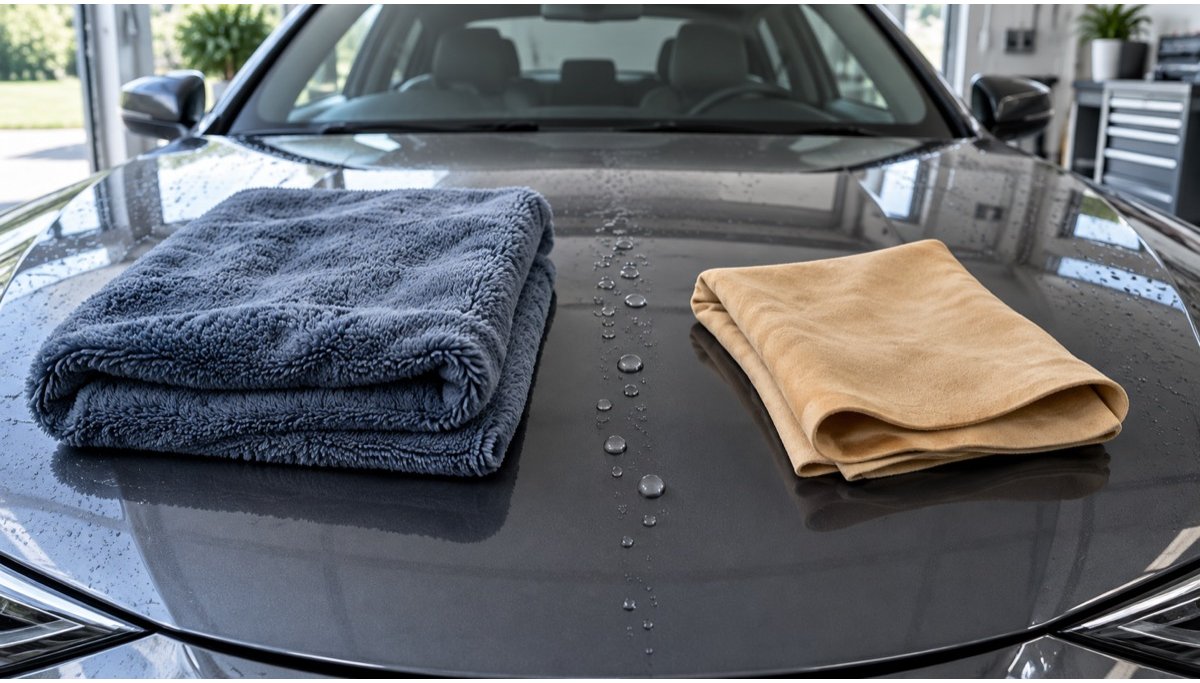
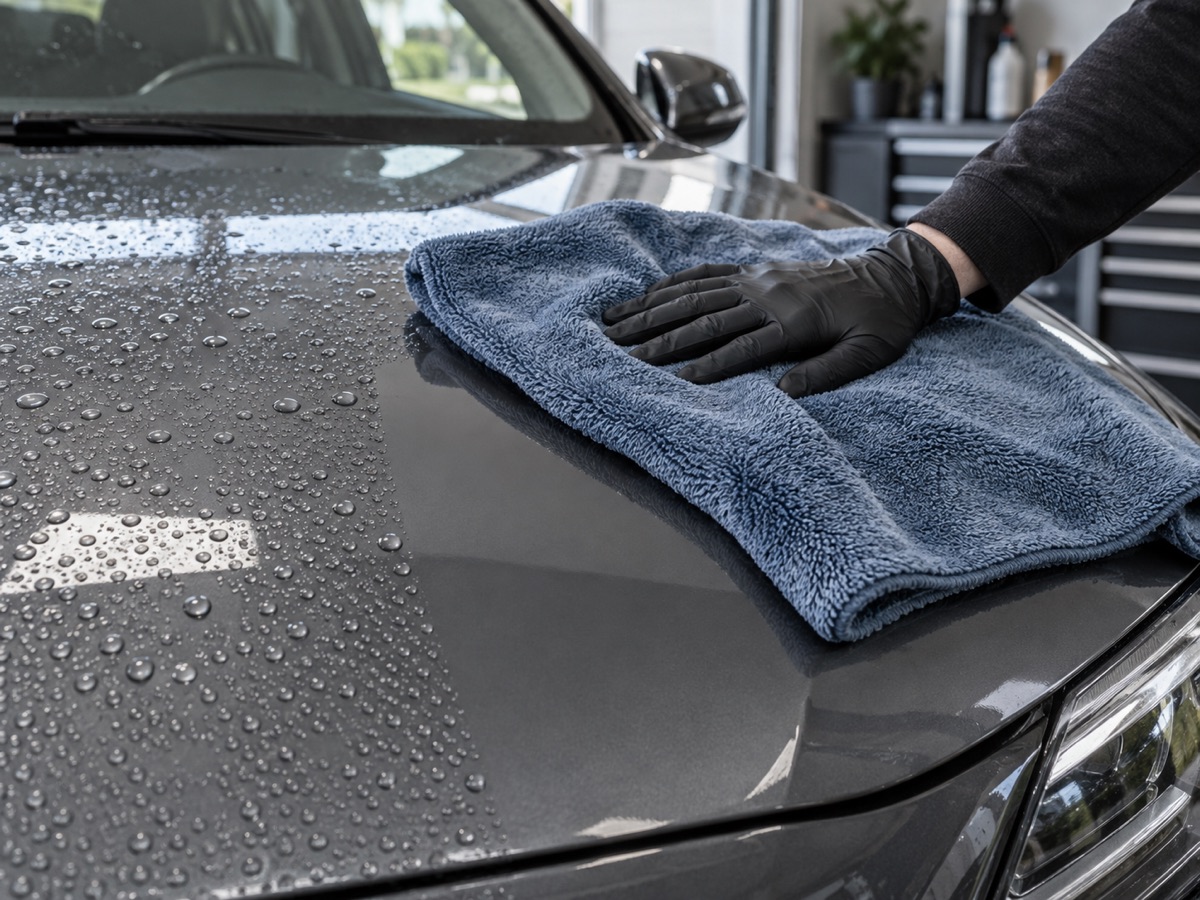
After the rinse
Choose the drying tool that fits your wash routine
A clean, dedicated microfibre drying towel is a straightforward first choice for most home car washes. A chamois can still be useful if you prefer a cloth that you can wring out repeatedly. The difference is in how the materials are handled and cared for, not a guarantee that one will leave every car spotless.
Start with a properly washed and rinsed car. Neither material makes dragging remaining grit over paint safe. If you are putting together a complete wash setup, see our car cleaning kit checklist.
Quick answer
For a first drying cloth, start with microfibre
Choose a dedicated, soft drying towel with enough area for your vehicle, then keep it clean and away from wheel tools. If you already like using a chamois, check whether it is natural leather or synthetic: their care instructions can differ. A small cloth may be handy for glass and tight areas but can require more wringing on a full vehicle.
Microfibre towel vs chamois at a glance
| Question | Microfibre drying towel | Chamois cloth |
|---|---|---|
| Best starting point | Dedicated towel for broad paint and glass areas after a thorough rinse. | A wringable alternative if you prefer that handling; check its material first. |
| What to compare | Finished size, weave, edge finish and the maker's wash instructions. | Natural leather or synthetic construction, size and the maker's care instructions. |
| While drying | Use clean sections; swap or rinse if the cloth picks up contamination. | Wring when saturated and keep the working face clean. |
| After the wash | Launder according to its label; avoid fabric softener when the maker says so. | Follow the exact leather or synthetic product's cleaning and storage directions. |
These are buying distinctions, not lab rankings. A towel's absorbency and feel depend on its actual construction and condition; a product name or GSM figure alone cannot prove performance on your car.
Which cloth suits your car and routine?
Think about how much clean surface you need before the cloth becomes wet, and where you will store it between washes.
One family car, regular home washes
A larger microfibre drying towel is an easy place to start. Compare its actual dimensions and edges, then keep a smaller clean cloth for mirrors, trim and glass if needed.
You prefer wringing as you work
Compare chamois options by material and care. A synthetic chamois is not the same as natural leather, even when both appear under the same shop category.
If you are considering a twisted-loop towel, compare its size and construction with other drying towels rather than assuming that the weave name alone settles the choice. See the twisted-loop range.
How to dry without undoing the wash
Rinse thoroughly
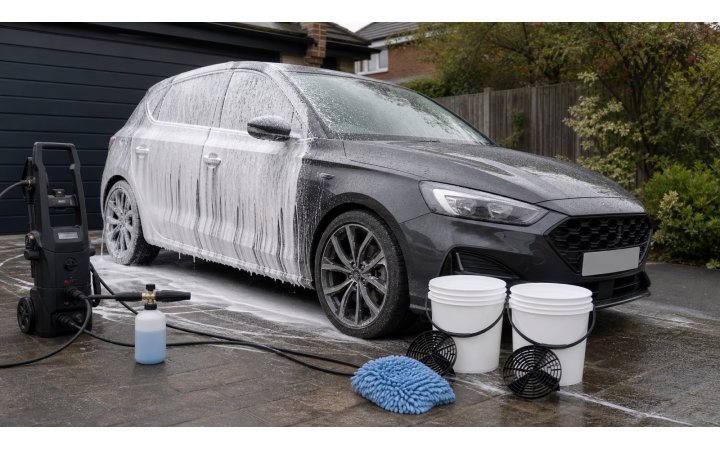
Wash and rinse away loose dirt and shampoo before the drying cloth touches the surface. Work on cool panels and avoid letting wash solution dry on them.
Start with a clean cloth
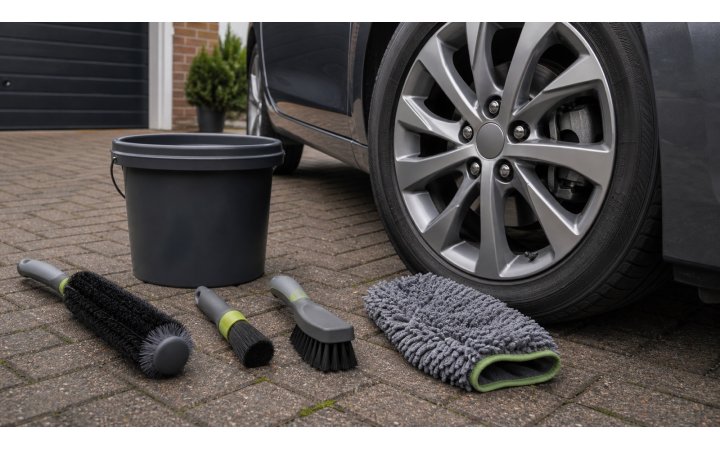
Check the face and edges for trapped debris. Keep drying cloths separate from wheel and tyre tools.
Use light contact
Let the material pick up water without pressing hard or scrubbing a missed dirty patch. Return to washing and rinsing if you find contamination.
Finish and care for it
Use clean sections for glass and trapped water, then clean and dry the cloth as its own label directs before storage.
Check these details on the product page
Size: compare the stated width and length, not just “XXL”. A 90 × 60 cm towel covers more area per pass than a 40 × 40 cm cloth, but may be less convenient in narrow spaces.
Material: “chamois” can mean natural leather or a synthetic cloth. Read the listing and care label before using washing advice intended for a different material.
GSM and weave: GSM describes fabric mass per square metre, not a tested drying capacity or scratch rating. Construction, edge finish, cleanliness and use still matter.
Care: for example, Autoglym says to wash its Ultra-Soft Drying Towel separately at up to 40°C without fabric softener, while its synthetic Aqua-Dry calls for occasional hand washing in warm water with mild detergent. Follow the instructions for the exact cloth you buy.
Examples to compare in the catalogue
These listings illustrate different formats; they are not hands-on recommendations or a claim that one outperforms another. Check the retailer listing for the current pack, price and availability.
Large microfibre towel
Airlab 90 × 60 cm, 500 GSM drying towel shows the larger towel format.
Twisted-loop towel
Airlab 90 × 60 cm, 650 GSM twisted-loop towel offers another weave to compare.
Synthetic chamois
Autoglym Hi-Tech Aqua-Dry is a synthetic chamois; confirm the listing's stated dimensions before ordering.
Common questions
Will a microfibre towel prevent scratches?
No cloth guarantees that. Wash and rinse the paint first, inspect the towel for trapped grit, and avoid pressure over any remaining dirt.
Is a chamois always natural leather?
No. The name is also used for synthetic drying cloths. Check the stated material and care instructions rather than relying on the category name.
Is a higher GSM always better?
No. GSM is one fabric specification. Finished size, weave, edges and how you use and maintain the towel also affect whether it suits your routine.
Sources and buying note
For wash and drying order, see Autoglym's shampoo instructions. Its Ultra-Soft Drying Towel and Hi-Tech Aqua-Dry pages give product-specific care directions. These sources explain use and care; they do not establish a universal performance ranking.
MotorStash product pages are comparison starting points. Offers, dimensions and availability can change at the retailer. This guide has not independently tested the linked cloths.